
How to Get a CDL in the United States: Step-by-Step Guide for New Truck Drivers
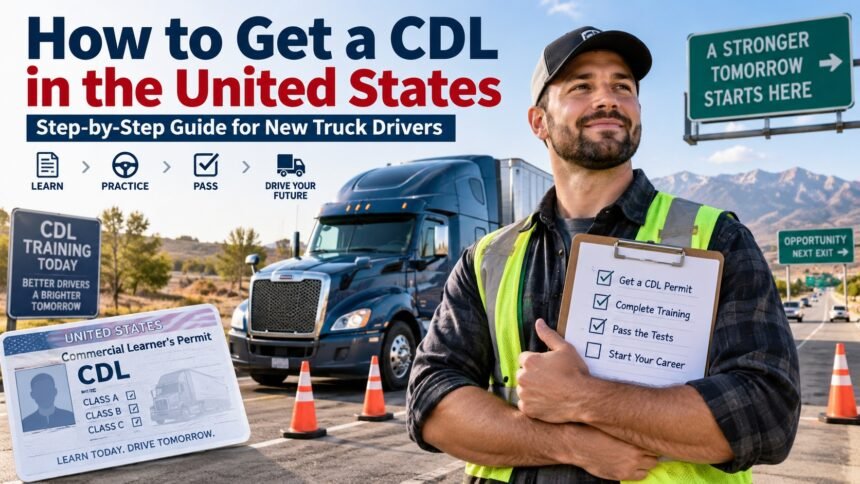
Getting a Commercial Driver’s License, better known as a CDL, is the main step for anyone who wants to work professionally driving semi-trucks, heavy straight trucks, buses or other commercial vehicles in the United States.
The CDL follows federal safety standards established by the Federal Motor Carrier Safety Administration, but the actual license is issued by each state. Because of that, fees, documents, testing appointments and some additional requirements can change depending on where you live.
For someone planning to drive a tractor-trailer, the most common choice is the Class A CDL. Class A generally covers combinations weighing 26,001 pounds or more when the vehicle being towed exceeds 10,000 pounds. Class B is generally used for heavy single vehicles, while Class C covers certain passenger and hazardous-material operations that do not fall under Class A or B.
First, check the age requirement
A driver can generally obtain a CDL or Commercial Learner’s Permit at 18 years old for intrastate commercial driving. To operate a commercial motor vehicle in interstate commerce, meaning work that crosses state lines or otherwise qualifies as interstate commerce, federal regulations generally require the driver to be at least 21 years old.
That difference matters for younger drivers. Someone who gets a CDL at 18 may be able to work inside the state but still face restrictions on interstate trucking until turning 21.
Get the CDL manual from your state
Before paying for a truck driving school, applicants should download the official CDL Manual from their state DMV or licensing agency.
Each state runs its own CDL process while meeting federal minimum standards. The manual explains the knowledge tests, required documents, air-brake rules and procedures used during the skills test.
For a future tractor-trailer driver, studying the correct sections is important because the exams can include general commercial-driving knowledge, combination vehicles and air brakes.
Federal standards require at least 80% correct answers to pass CDL knowledge and endorsement tests.
A DOT medical exam may be required
Drivers working in non-excepted interstate commercial operations generally need to meet federal medical requirements.
The DOT physical must be performed by a medical examiner listed on the FMCSA National Registry. When a driver qualifies, the examiner issues the medical certification required for commercial driving. A certification can normally be valid for up to 24 months, although a shorter period can be issued when a medical condition needs closer monitoring.
Medical certification rules can differ for intrastate drivers and for certain excepted operations, so applicants should check the category that applies to their job.
The next step is the Commercial Learner’s Permit
Before getting the full CDL, most new drivers first obtain a Commercial Learner’s Permit, or CLP.
The applicant goes to the state licensing agency, provides the required identification and residency documents, meets the applicable medical requirements and passes the required knowledge exams.
The CLP allows the applicant to practice driving a commercial vehicle on public roads, but a qualified CDL holder must accompany the learner as required by the rules.
Under the current federal process, an applicant must hold the CLP for at least 14 days before taking the CDL skills test.
New drivers must complete ELDT training
One of the biggest changes to getting a CDL came with the Entry-Level Driver Training, or ELDT, regulations.
Someone obtaining a Class A or Class B CDL for the first time must complete the required training through a provider listed on the FMCSA Training Provider Registry before taking the CDL skills test. The requirement also applies when upgrading from a Class B to Class A and when obtaining certain endorsements for the first time.
For a Class A or B CDL, ELDT includes theory instruction and behind-the-wheel training on a range and public roads.
Federal regulations do not establish a fixed minimum number of hours for the theory portion, although states can impose additional training requirements. The training provider reports successful completion electronically to the federal registry.
This means applicants should verify that a school or company is registered with FMCSA before paying for CDL training.
Then comes the CDL skills test
After meeting the CLP waiting period and completing the required ELDT training, the applicant can take the CDL skills test.
The examination has three main parts: Vehicle Inspection, Basic Controls and Road Test. The applicant must demonstrate that the commercial vehicle is safe, control it during maneuvers and then drive safely in real traffic.
The vehicle used for the test matters.
For example, someone who takes the skills test in a commercial vehicle equipped with an automatic transmission receives an E restriction, which prevents that CDL holder from operating a manual-transmission commercial vehicle. Air-brake restrictions can also be placed on the license depending on the vehicle and tests completed.
For drivers who want the widest range of tractor-trailer jobs, this is something worth checking before scheduling the test.
What endorsements can be added?
After choosing the CDL class, drivers may also need endorsements for specific types of work.
The federal CDL system includes endorsements for double and triple trailers (T), passenger vehicles (P), tank vehicles (N), hazardous materials (H), school buses (S), and the combined tank and hazardous-material endorsement (X).
A driver who plans to haul standard dry-van or refrigerated tractor-trailers may not need all of these. Tanker, HazMat and specialized trucking jobs can require additional tests and qualifications.
Can immigrants get a CDL in the United States?
Immigration status can affect CDL eligibility, particularly for people who do not qualify for a standard CDL issued by their state of domicile.
Rules for non-domiciled CDLs changed in 2026. Under the current federal rule, non-domiciled CDL or CLP eligibility is limited to qualifying applicants in certain employment-based nonimmigrant statuses, specifically H-2A, H-2B or E-2, along with the other federal requirements. U.S. citizens and lawful permanent residents who are domiciled in a state can qualify for a standard CDL if they meet the normal eligibility requirements.
Because immigration and licensing situations can differ substantially, applicants who are not U.S. citizens or permanent residents should verify their eligibility with the state licensing agency before paying a CDL school.
How long does it take to get a CDL?
There is no single nationwide answer. The federal rules establish requirements such as the CLP, the 14-day minimum waiting period, ELDT training and testing, but states and training providers control much of the scheduling process.
A student’s timeline can therefore depend on truck-driving school availability, how quickly they pass the written exams, time behind the wheel and how soon a skills-test appointment is available.
Once the driver passes all three portions of the skills test and completes the state paperwork, the state can issue the CDL. Some states provide the commercial license immediately, while others send the physical card later.
For someone whose goal is driving a semi-truck across the United States, the usual path is Class A CDL + DOT medical qualification + CLP + ELDT training + skills test, followed by any endorsements required for the type of freight they want to haul.

João Neto
Brasil do Trecho editorial team, covering trucks, buses, logistics, road transport and the Brazilian transportation industry.
Related News
 Read article: F-14 Tomcat fighter jet hauled 2,700 miles by semi truck from Florida to Colorado
 Read article: Truck Drivers Defend Sparhawk as Wisconsin Carrier Shuts Down After Decades in Business
 Read article: Wisconsin Trucking Company Shuts Down After Bankruptcy and Failed Sale
 Read article: 78-Year-Old Trucker Found Dead Beside His Rig After Hours at Mississippi Rest Area