
Driver Shortage Pushes U.S. Fleets Toward Predictive Safety and Driver Scoring
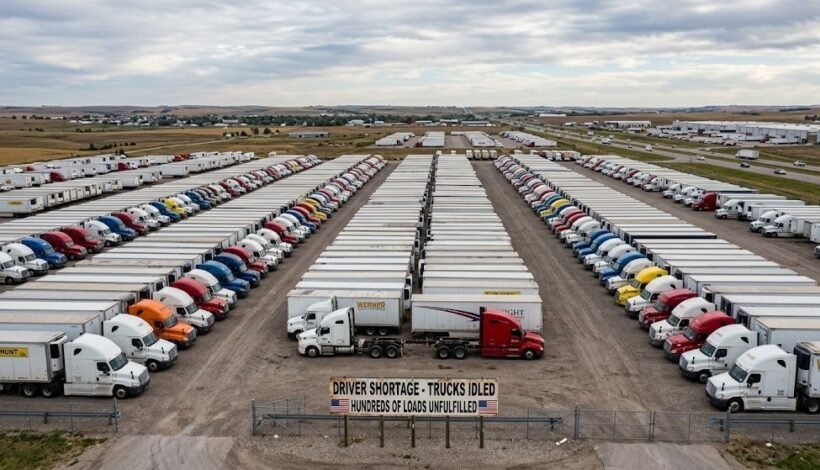
The shortage of qualified truck drivers is changing more than recruiting in the U.S. trucking industry. It is also changing the way private fleets deal with drivers who show signs of risky behavior.
Instead of waiting for a crash — or simply terminating a driver and trying to find a replacement — some fleets are using driver scores, cameras, telematics and predictive analytics to identify problems earlier.
Dot Foods is one of the companies taking that approach.
The food distributor’s transportation operation runs nearly 2,200 trucks across the U.S. and Canada, according to comments made during the International Foodservice Distributors Association’s 2026 Solutions Conference in San Antonio.
For a fleet that large, reviewing every speeding alert, hard-braking event or camera notification individually can quickly become overwhelming.
The strategy now is to find the drivers who need attention most.
Drivers receive a risk score from 0 to 100
Dot Foods uses a scoring system that ranges from zero to 100, with zero representing the best performance.
Drivers who score above 70 are placed on a professional development plan and receive additional monitoring. The company focuses much of its attention on roughly the bottom 10% to 20% of its driver population, although that group changes as individual performance improves or declines.
As of the week before the September conference, only about 30 Dot drivers had scores above 70, according to Tim Eckhardt, senior director of safety at Dot Foods.
The goal is not automatically to fire them.
Development plans can include additional training, coaching, ride-alongs and other interventions aimed at the specific behavior creating risk.
That represents a significant shift from the traditional approach to fleet safety.
Speeding and distracted driving are major targets
Among the behaviors Dot monitors closely are speeding and distracted driving.
Modern trucks can generate enormous amounts of safety data through telematics, onboard cameras and other systems. The challenge is deciding which events represent a pattern and which drivers present a higher risk of a serious crash.
Dot previously relied on an internally developed risk-management system that involved significant manual data entry. As the fleet grew, the system became harder to maintain and lacked the predictive capabilities the company wanted.
The fleet later adopted Descartes Fleet Safety technology to centralize information and make it easier to identify driver risk before an accident occurs. Descartes reports that Dot saw a 30% improvement in safety-team efficiency after implementing the platform.
The next target is driver fatigue
Fatigue is also moving into the predictive-safety conversation.
Dot Transportation announced this month that it is piloting the Readi fatigue-management platform from Fatigue Science. The system is designed to estimate a driver’s fatigue risk before and during an upcoming shift rather than waiting for a fatigue-related event to occur.
The technology provides hour-by-hour fatigue predictions and does not require drivers to wear a device, according to information released about the pilot.
That matters in an industry where a driver can legally be within hours-of-service limits and still be tired because of sleep quality, schedules or other factors.
Fleets cannot afford to simply replace every struggling driver
The labor market is one reason this type of safety strategy is attracting attention.
Qualified commercial drivers can be difficult and expensive to replace. The U.S. Department of Transportation’s 2026 National Freight Strategic Plan also points to an aging workforce, reporting an average age of 57.87 years for private-fleet drivers and warning that younger workers will need to be recruited and trained as existing drivers retire.
At the same time, a serious truck crash can expose a carrier to medical expenses, equipment losses, insurance increases and costly litigation.
The result is a different calculation for fleets: identifying a driver’s problem early and helping that driver improve may be safer and less expensive than waiting for an accident or constantly replacing employees.
Federal research has also examined this concept. An FMCSA field test of onboard monitoring systems evaluated whether targeted feedback based on risky driving behavior could improve commercial-driver safety performance. The study involved roughly 200 vehicles and collected more than 30 million miles of naturalistic truck and bus driving data.
Safety data is becoming a coaching tool
Dot Foods says the move toward predictive analytics has coincided with significant improvements in its safety results. In a 2025 interview published by IFDA, Eckhardt said the company’s data-driven strategy had helped it achieve record-low accident rates in three of the previous four years.
The larger change may be cultural.
Cameras and telematics have often been viewed by drivers mainly as surveillance tools. Fleets such as Dot are increasingly trying to use that same data to answer a different question:
Which driver is beginning to show a pattern that could lead to the next crash — and what can the company do before it happens?
For U.S. private fleets facing tighter labor conditions and rising accident exposure, the answer is increasingly becoming prediction, targeted coaching and driver development rather than reaction after the crash.

João Neto
Brasil do Trecho editorial team, covering trucks, buses, logistics, road transport and the Brazilian transportation industry.