BYD Plans European Truck Production as Chinese Giant Targets Heavy-Duty Market
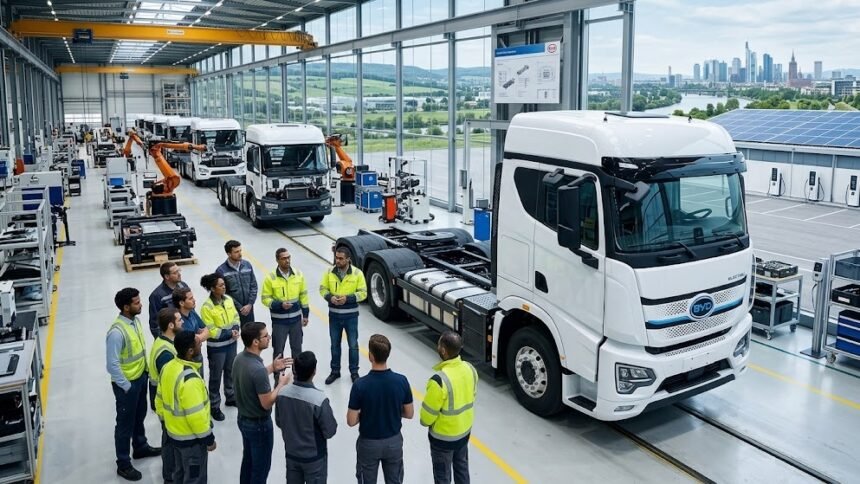
Chinese electric vehicle giant BYD is preparing a major push into Europe’s heavy-duty truck market, with plans to launch its first heavy-duty truck on the continent in 2027 and eventually manufacture trucks locally.
The announcement was made during the IAA Transportation trade fair in Hanover, Germany, where BYD Executive Vice President Stella Li outlined the company’s long-term strategy for Europe. According to Reuters, BYD intends to produce the vehicles it sells in Europe locally as its presence in the region grows.
The move could put additional pressure on established European truck manufacturers such as Mercedes-Benz Trucks, Volvo, Scania, MAN, DAF and Iveco, which are already investing heavily in battery-electric trucks.
BYD, however, appears to be planning more than simply importing vehicles from China.
BYD wants to become a local European manufacturer
Stella Li said the company’s long-term plan is to manufacture locally rather than rely mainly on imported vehicles.
That strategy could help BYD reduce exposure to possible European tariffs on Chinese-made electric trucks. Some European manufacturers, including MAN, have already called for the European Union to consider tariffs on Chinese electric trucks similar to those applied to Chinese electric passenger vehicles.
Local manufacturing would also allow BYD to position itself differently with European fleet operators.
The company is already expanding its passenger-vehicle manufacturing footprint in Europe. A new BYD factory in Szeged, Hungary, is expected to begin mass production next year.
That plant currently focuses on passenger vehicles, but BYD’s truck strategy shows the company wants a much broader industrial presence in Europe.
First heavy-duty truck expected in 2027
BYD plans to introduce its first heavy-duty truck for the European market next year.
The company has not yet released complete technical specifications, pricing or confirmed where the heavy truck will eventually be manufactured.
The timing is important.
Electric heavy trucks are becoming a major battleground in Europe as governments push for lower transport emissions and manufacturers develop battery-electric alternatives for regional and long-haul operations.
BYD will be entering a market where traditional truck manufacturers already offer electric models and have extensive dealer and service networks.
That means the Chinese manufacturer will need more than an electric truck with competitive specifications.
BYD plans charging, financing and roadside support
One of the most significant parts of BYD’s strategy is its plan to offer fleet customers a broader package rather than just selling the vehicle.
According to Reuters, BYD wants to provide financing, solar-powered charging infrastructure and a workshop network supported by mobile roadside assistance.
For trucking companies, those services can be just as important as the truck itself.
A fleet considering electric vehicles must calculate charging availability, vehicle downtime, maintenance costs, financing and the ability to receive roadside assistance when a vehicle breaks down.
By trying to provide those services together, BYD appears to be targeting the same large fleet customers that traditionally rely on established truck manufacturers.
Chinese truckmakers are increasing pressure in Europe
BYD is not the only Chinese company looking toward Europe.
Several Chinese manufacturers are using the IAA Transportation show to increase their presence in the European commercial-vehicle market. Companies including Farizon, Sany, Sinotruk, Windrose and SuperPanther are also pushing electric truck technology toward European customers.
The growing presence of Chinese manufacturers comes as the European trucking industry faces a difficult transition.
Major European truckmakers have asked for more time to meet upcoming European Union CO₂ reduction targets, arguing that charging infrastructure, grid connections and operating economics are not developing fast enough. Only about 2.4% of new heavy-duty vehicles in Europe are currently zero-emission, according to Reuters.
That could create both an opportunity and a challenge for BYD.
The company has extensive experience with batteries and electric vehicles, but success in heavy trucking depends on vehicle durability, payload, charging time, range, service coverage and total operating cost.
Competition with traditional truck brands could intensify
BYD’s arrival will not immediately change the balance of Europe’s heavy-truck market.
Companies such as Volvo, Daimler Truck, Traton, Scania, DAF and Iveco have decades of experience with heavy-duty vehicles and established relationships with major logistics companies.
But BYD has already shown in passenger vehicles that it is willing to invest aggressively in international expansion.
The decision to eventually manufacture trucks in Europe indicates that the company is treating the heavy-duty market as a long-term business rather than a limited export project.
BYD has not yet announced the final production location for its European heavy-duty trucks or the price of the first model.
What is already clear is that 2027 could mark the beginning of a new phase of competition in Europe’s truck market, with BYD moving from passenger cars and buses into one of the most demanding segments of commercial transportation.

João Neto
Brasil do Trecho editorial team, covering trucks, buses, logistics, road transport and the Brazilian transportation industry.