
Inside America’s “Olympics of Truck Driving,” Where Drivers Compete in a Game of Inches
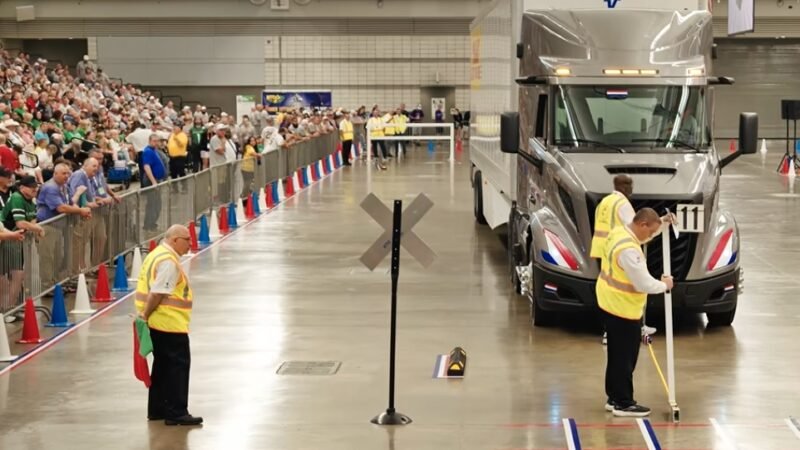
A 30,000-pound empty flatbed truck rolls toward a target barely larger than a person’s hand. The driver’s job is not simply to avoid hitting something. The goal is to stop within inches of the perfect spot.
That is the strange precision behind the National Truck Driving Championships, an event often described as the “Olympics of truck driving.” The competition brings professional drivers together to prove who can best control some of the largest vehicles on the road.
The event was held inside a convention center in Pittsburgh, where trucks competed on an indoor course surrounded by spectators, judges and teams representing some of the biggest names in American transportation. The championship is organized by the American Trucking Associations, and companies including FedEx, XPO, Walmart and UPS had drivers in the competition.
But this is not a race.
Drivers are judged on how precisely they can maneuver their trucks through a series of challenges. They may need to stop at an exact point, position an axle over a scoring pad, make tight turns or estimate distances while sitting high above the pavement.
One experienced competitor explained the unusual nature of the contest. On a normal workday, truck drivers try to stay as far away from obstacles as possible. During the championship, they are asked to do almost the opposite: get extremely close without touching anything.
Inches can separate the best drivers
Judges are stationed throughout the course. After each challenge, a green flag means the driver earned points, while a red flag means a zero for that obstacle. Drivers do not immediately know their exact score.
Some challenges are decided by only a few inches.
In one exercise, drivers have to align a piece of tape mounted on the side of the truck with a measuring device. Another requires them to stop as close as possible to a dock without hitting it.
A perfect score on one stopping exercise could require the truck to finish within about six inches of the target.
That kind of precision becomes even more difficult when the driver is controlling a tractor-trailer that may stretch dozens of feet from the front bumper to the rear axle.
Drivers also have to find hidden truck problems
Driving is only part of the competition.
Another major section is the pre-trip inspection, where officials intentionally place mechanical or safety defects on a truck. Drivers then have limited time to inspect the vehicle and identify as many problems as possible.
The defects can range from something small, such as a misaligned mirror or windshield damage, to more serious equipment problems.
This section alone is worth 100 points, roughly one-third of the total score described in the source material.
The exercise mirrors what professional truck drivers are expected to do before heading onto public roads. A driver is responsible for checking equipment and spotting conditions that could make a truck unsafe.
Experience does not make the course easy
Some competitors have spent decades behind the wheel.
One driver from Alaska said he had been trucking for 44 years and described working with extremely heavy loads that required pilot vehicles, additional tires and support crews. Yet even experienced drivers described the championship course as difficult.
Preparation matters because drivers have to study the course and memorize visual reference points.
A cone, piece of tape or barrier that looks insignificant to a spectator can become an important marker from inside the cab. Drivers use those references to determine where their tires, axles and trailer are located even when they cannot directly see them.
More than 400 drivers reached the national event
The scale of the championship becomes clearer during the finals.
The names of more than 400 competitors were announced while families, co-workers and company teams watched from the stands. The five highest-scoring drivers from each vehicle class advanced to the final round.
The final course added new challenges.
One simulated a railroad crossing. Drivers had to stop as close as possible to a point 15 feet before the crossing.
Another challenge used a shrinking bull’s-eye that was difficult to judge even while standing on the ground. From inside a truck cab, drivers had to rely on preparation, memory and spatial awareness to place the vehicle correctly.
No big cash prize, but plenty of competition
Unlike many professional competitions, the championship is not centered on a large cash prize.
Drivers compete for trophies, recognition and the chance to become a national champion. The event also gives truckers an opportunity to demonstrate skills that are difficult for the public to see during everyday highway driving.
For many competitors, that recognition appears to be part of the attraction. The event allows families and co-workers to see the precision, preparation and safety knowledge involved in professional truck driving.
The championship ultimately crowned a FedEx driver competing in the four-axle class as the 2026 NTDC Grand Champion. After winning, the driver emphasized three ideas that run through the entire event: hard work, consistency and putting safety first.

João Neto
Brasil do Trecho editorial team, covering trucks, buses, logistics, road transport and the Brazilian transportation industry.
Related News
 Read article: U.S. Tightens CDL Rules as High Diesel Prices Put More Pressure on Truckers
 Read article: U.S. Allows Some Truckers to Drive Up to 16 Hours as Diesel Prices Surge
 Read article: Are U.S. Truckers Really Shutting Down on October 1? Here’s What We Know
 Read article: U.S. diesel rises to $6.529 a gallon, squeezing truckers’ margins